Track the success of your QR codes, get user statistics and change the target URL on the fly. Those are some of the benefits of Dynamic QR Codes. New customers get 10.000 free scan's yearly with the limited time free early-bird license. Start now by creating an account
Dynamic QR Code created. Click here to manage them
Please complete the required fields:
URL
Dynamic URL
The domain that is visible when scanning the QR Code.
The internal name for the QR Code.
The URL that is opened when scanning the QR Code.
Text
vCard
The domain that is visible when scanning the QR Code.
The internal name for the QR Code.
Wifi
Phone
SMS
Calendar
Geolocation
Cryptocurrency
The domain that is visible when scanning the QR Code.
The internal name for the QR Code.
Square shape
Inner eye shape
Outer eye shape
Frame
Frame colors














* When a logo is used inside the QR code, the error correction level will always be set to Extra High.
* When using a frame, the border size might be ignored
Download as:
*jpeg does not support transparent colors
Embed QR Code:
Free 3D QR Code Generator
What is a 3D QR Code?
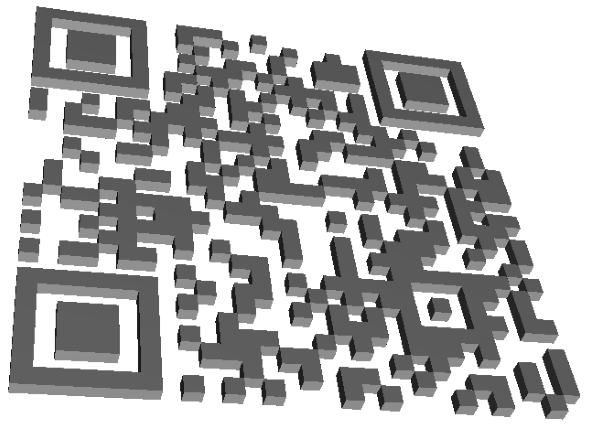
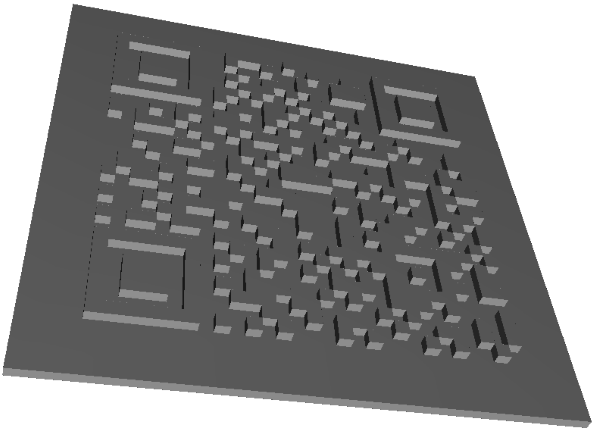
A 3D QR Code is a QR code that can be used for 3D modeling and 3D printing.
Why would I use a 3D QR Code?
When you are designing or creating a 3D model / product, and you want to incorporate a QR Code, then this is a good starting point.
Is it really free?
Indeed, you can download the 3D QR Code and use it in any project you want totally for free.
My 3D QR Code is not rendering correctly
The original QR codes are 2D. How we create a 3D object is by stretching the black part of the QR code out. So try to use the original black/white colors for the best result. We are currently working on making the other colors also work.
Which 3D formats do you provide support for, and what is the difference?
We support STL, 3MF, OBJ and USDZ. The best format depends on whether you want to 3D print the QR Code, use it in 3D software, or view it on an Apple device.
STL files lack color information and details about unit size. Some software attempts to incorporate color information unofficially, which might not be compatible across all platforms. Additionally, due to their data formatting, STL files tend to be larger compared to other formats.
3MF files encompass color information and unit size, and they typically have a smaller file size compared to STL files. Certain 3D printer software can autonomously identify color shifts and seamlessly incorporate filament changes. While our current support is limited to black and white, we have plans to include additional color options in the future.
OBJ files are similar to 3MF files. We do support full color on the OBJ files, but it requires 2 additional files. The MTL file and the texture (PNG in our case). Therefore, when you download the OBJ file, you will receive a .ZIP file containing these.
USDZ is intended for viewing 3D QR Codes on iPhone and iPad with Apple Quick Look. It is ideal for interactive previews and augmented-reality viewing on supported Apple devices, rather than as the main format for 3D printing.
What can you use a 3D QR Code for?
A 3D QR Code turns a digital link into a physical part of your product or design. It can be raised from a surface, printed in one or more colours, or included in a digital 3D model.
- 3D-printed products: Add a scannable link to product packaging, keychains, signs, displays, nameplates, or promotional items.
- Product information: Link a printed object to instructions, a product page, a video, contact details, or a warranty page.
- Events and exhibitions: Put a durable QR Code on a stand, display, prototype, or museum object.
- Design and prototyping: Include a QR Code in a CAD or 3D-model workflow before manufacturing.
- Apple previews: Share a USDZ version so people with an iPhone or iPad can inspect the model in Quick Look.
Tips for 3D printing a QR Code
For the most reliable result, use strong contrast between the raised QR Code and its base. Keep the individual QR modules large enough for your printer to reproduce cleanly, avoid very fine details around the code, and test it with a phone before producing multiple prints. STL and 3MF are usually the best choices for 3D printing; 3MF is especially useful when your printer workflow supports colour or multi-material information. For more guidance, read our guide to printing the perfect 3D QR Code.

Social Media